Título1
"Cooperative learning using Wiki methodology, or "how to achieve better quality with less effort": a case study in experimental sciences"
Summary of the eperience
(d’aproximadament 200 paraules, cosa que representa unes 15 línies de lletra tipus Times New Roman 12 pt)
Development
(tindrà una extensió màxima de 1.600 paraules, cosa que equival a unes 3-4 pàgines amb lletra tipus Times New Roman 12 pt, a interlineat senzill, i es presentarà amb l’estructura següent)
i. Objetives
ii. Description of the work
Acknowledgments
- DURSI (2004 - 2005): Ref. 2003MQD00167
- UB-REDICE (2005-2006)
- Ourproject.org server
- Library of Biology Faculty (UB)
- Tikiwiki community
Introduction
- "Traditional methodology" vs. "Wiki methodology"
- Underground philosophy
- Thecnology
- Quality
- Effort
Methodology
Especificitats AIA
Criteris d'avaluació dels treballs:
- Treball en equip:
- Síntesi de la informació:
- Claredat expositiva (paper o oral):
- Cerca d'informació:
- Nombre i qualitat de les referències documentades:
Visualització de resultats
iii. Results and Conclusions
Results-1
The most significant results are shown below for the subject AIA, from which the more extense and single balanced data-set was collected (ca. 30 with Traditional methodology
vs. ca. 30 with Wiki methodology).
Technology use:
...
Methodological issues:
Students who worked with Wiki methodology in subject AIA didn't employed the diskettes or USB memories so much (Figure Q25 AIA0405), they apparently used the telephone less (Q26 AIA 0405), and they did not use the e-mail as much as the students that used the traditional methodology of work in group (Figure Q28 AIA 0405). It is necessary to add that the question 29 of the survey (degree of utilization of the Wiki, Figure Q29 AIA 0405) shows that the students who did not use the Wiki confused it with the Web Page of support, where they also connected to, in order to use the forums, and to read the notes and notices from the teaching staff, but not to write collaboratively any texts via Wiki because they Wiki technology didn't allowe them.
Mètode de treball emprat
-----------
Qüestions organitzatives del grup de treball d'alumnes
-----------
El temps invertit pels alumnes que han fet servir Wiki és superior a la dels que no ho han fet servir?
-----------
La nota i l'eficiència -nota respecte temps invertit- pels alumnes que han fet servir Wiki és superior a la dels que no ho han fet servir?
-----------
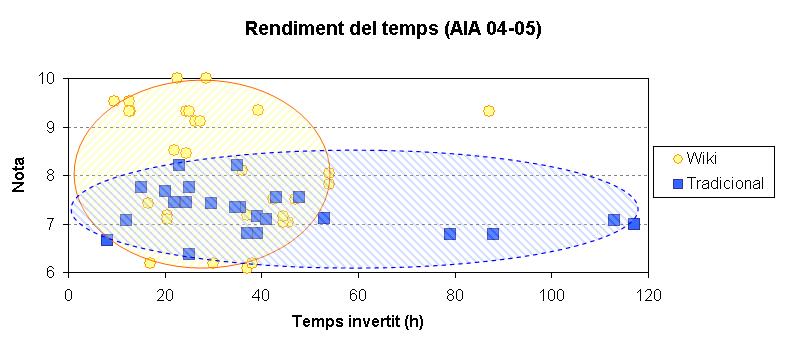
La distribució de l'esforç és més equilibrat en el temps dels alumnes que han fet servir Wiki respecte els que no ho han fet servir?
-----------
La satisfacció en la metodologia emprada dels alumnes que han fet servir Wiki és superior a la dels que no ho han fet servir?
-----------
El suport i la comunicació dels alumnes amb el professorat que han fet servir Wiki és superior a la dels que no ho han fet servir?
-----------
Temps invertit per ítems
-----------
Comparison on further comments from students' surveys
Results-2
(Figure: assessment respect time invested of groups using wiki vs. traditional methodology)
Conclusions-1
- Big groups (15): Wiki methodology enhances better (higher marks) and earlier (more balaced distribution of effort along time) cooperation in the classrom... and out of it!
- The role of "Head of writing" / "Editor in chief" / ... is needed for higer quality, regardless of methodology followed.
- (the others stated at the general paper)
iv. Bibliography
(treure de l'informe)
Notas de la revista
[+]
---------------------------
Journal of Educational Technology & Society
http://www.ifets.info/
Peer review manuscript preparation guidelines
---------------------------
(These guidelines apply to all full length papers, short papers, critiques and case studies)
Word length of submission
* Full paper: 4000 to 7000 words
* Short paper: up to 3000 words
* Critique: up to 3000 words
* Case study: up to 3000 words
General guidelines
Each article should have at least following items:
* title (up to 10 words)
* complete communication details of all authors
* an informative abstract (75 to 200 words) presenting the main points of the paper and the author's conclusions
* four - five descriptive keywords
* main body of paper
* conclusion
* references
Submissions should be single spaced.
Footnotes and endnotes are not accepted, all such information should be included in main text.
The paragraphs should not be indented. There should be one line space between consecutive paragraphs.
There should be single space between full stop of previous sentence and first word of next sentence in a paragraph.
The keywords (just after the abstract) should be separated by comma, and each keyword phrase should have initial caps (for example, Internet based system, Distance learning).
Do not use 'underline' to highlight text. Use 'italic' instead.
Headings
Articles should be subdivided into unnumbered sections, using short, meaningful sub-headings. Please use only two level headings as far as possible. Use 'Heading 1' and 'Heading 2' styles of your word processor's template to indicate them. If that is not possible, use 12 point bold for first level headings and 10 point bold for second level heading. If you must use third level headings, use 10 point italic for this purpose.
There should be one blank line after each heading and two blank lines before each heading (except when two headings are consecutive, there should be one blank like between them).
Tables
Tables should be included in the text at appropriate places and centered horizontally. Captions (maximum 6 to 8 words each) must be provided for every table (above the table) and must be referenced in the text.
Figures
Figures should be included in the text at appropriate places and centered horizontally. Captions (maximum 6 to 8 words each) must be provided for every figure (below the figure) and must be referenced in the text. The figures must NOT be larger than 500 pixels in width.
Please provide all figures separately in GIF or JPEG (JPG) formats besides embedding them in the text.
References
All references should be listed in alphabetical order at the end of the article under the heading 'References'.
All references must be cited in the article using "authors (year)" style e.g. Merrill & Twitchell (1994) or "(authors1, year1; authors2, year2)" style e.g. (Merrill, 1999; Kommers et al., 1997).
Do not use numbering style to cite the reference in the text e.g. "this was done in this way and was found successful
23."
It is important to provide complete information in references. Please follow the patterns below:
Journal article
Laszlo, A. & Castro, K. (1995). Technology and values: Interactive learning environments for future generations. Educational Technology, 35 (2), 7-13.
Newspaper article
Blunkett, D. (1998). Cash for Competence. Times Educational Supplement, July 24, 1998, 15.
or
Clark, E. (1999). There'll never be enough bandwidth. Personal Computer World, July 26, 1999,
http://www.vnunet.co.uk/News/88174.
Book (authored or edited)
Brown, S. & McIntyre, D. (1993). Making sense of Teaching, Buckingham: Open University.
Chapter in book/proceedings
Malone, T. W. (1984). Toward a theory of intrinsically motivating instruction. In Walker, D. F. & Hess, R. D. (Eds.) Instructional software: principles and perspectives for design and use, California: Wadsworth Publishing Company, 68-95.
Internet reference
Fulton, J. C. (1996). Writing assignment as windows, not walls: enlivening unboundedness through boundaries, retrieved July 7, 2002 from
http://leahi.kcc.hawaii.edu/org/tcc-conf96/fulton.html

 Version

