

Article Wikis AIA0405
Table of contents
"Cooperative learning using Wiki methodology, or "how to achieve better quality with less effort": a case study in experimental sciences"
(d’aproximadament 200 paraules, cosa que representa unes 15 línies de lletra tipus Times New Roman 12 pt)
(tindrà una extensió màxima de 1.600 paraules, cosa que equival a unes 3-4 pàgines amb lletra tipus Times New Roman 12 pt, a interlineat senzill, i es presentarà amb l’estructura següent)
i. Objetives
ii. Description of the work
Acknowledgments
- DURSI (2004 - 2005): Ref. 2003MQD00167
- UB-REDICE (2005-2006)
- Ourproject.org server
- Library of Biology Faculty (UB)
- Tikiwiki community
Introduction
- "Traditional methodology" vs. "Wiki methodology"
- Underground philosophy
- Thecnology
- Quality
- Effort
Methodology
- Treball en equip:
- Síntesi de la informació:
- Claredat expositiva (paper o oral):
- Cerca d'informació:
- Nombre i qualitat de les referències documentades:
iii. Results and Conclusions
Results-1
The most significant results are shown below for the subject AIA, from which the more extense and single balanced data-set was collected (ca. 30 with Traditional methodology vs. ca. 30 with Wiki methodology).Technology use:
...
Methodological issues:
Students who worked with Wiki methodology in subject AIA didn't employed the diskettes or USB memories so much (Figure Q25 AIA0405), they apparently used the telephone less (Q26 AIA 0405), and they did not use the e-mail as much as the students that used the traditional methodology of work in group (Figure Q28 AIA 0405). It is necessary to add that the question 29 of the survey (degree of utilization of the Wiki, Figure Q29 AIA 0405) shows that the students who did not use the Wiki confused it with the Web Page of support, where they also connected to, in order to use the forums, and to read the notes and notices from the teaching staff, but not to write collaboratively any texts via Wiki because they Wiki technology didn't allowe them.

Mètode de treball emprat
Qüestions organitzatives del grup de treball d'alumnes
El temps invertit pels alumnes que han fet servir Wiki és superior a la dels que no ho han fet servir?
La nota i l'eficiència -nota respecte temps invertit- pels alumnes que han fet servir Wiki és superior a la dels que no ho han fet servir?
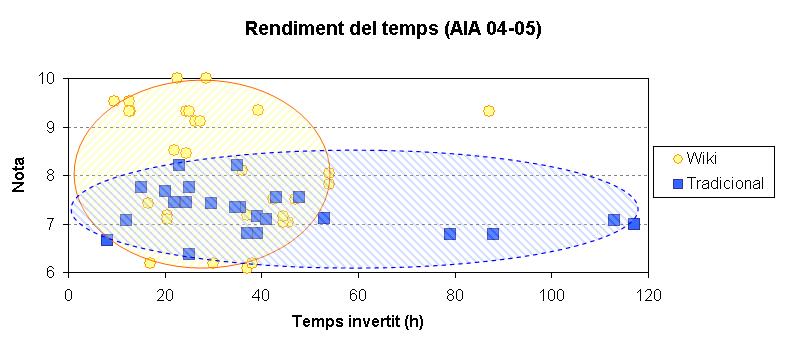
La distribució de l'esforç és més equilibrat en el temps dels alumnes que han fet servir Wiki respecte els que no ho han fet servir?
La satisfacció en la metodologia emprada dels alumnes que han fet servir Wiki és superior a la dels que no ho han fet servir?
El suport i la comunicació dels alumnes amb el professorat que han fet servir Wiki és superior a la dels que no ho han fet servir?
Temps invertit per ítems
Results-2
(Figure: assessment respect time invested of groups using wiki vs. traditional methodology)Conclusions-1
- Big groups (15): Wiki methodology enhances better (higher marks) and earlier (more balaced distribution of effort along time) cooperation in the classrom... and out of it!
- The role of "Head of writing" / "Editor in chief" / ... is needed for higer quality, regardless of methodology followed.
- (the others stated at the general paper)


