
History: aw2l 3.1 Results
Preview of version: 3

 Version

Results
There where a total of 229 surveys and 223 auto-recording tables collected (divided in methodologies and subjects in Table 1 in the accompanying communication; De Pedro, 2006).Among the items answered in the collected surveys, some results are shown for the subject AIA in detail, from which the more extensive and balanced data-set was gathered (circa 30 students with Traditional methodology versus circa 30 with Wiki methodology).
Methodological issues:
Students with Wiki methodology did not use as much the more common ways of communication (phone, chat or instant messaging, e-mail) and of exchange of documents (floppies, USB-drives, ...), but they employed more the Wiki technology. Moreover, meetings in person were reduced in the groups of students that followed Wiki methodology.
Organisational issues
In general, first-cycle students showed less difficulties to hold meetings during the week than those of second cycle. This is totally justifiable due to the bigger dispersion in subjects of last-years students, in spite of the case that subject was compulsory or optional in the degree.
The difficulties of internal organisation inside groups were very heterogeneous, and they did not seem to be tied to the work methodology but more to the characteristics of each group of students.
Marks and time yield
In very big work groups (AIA, 15 students for group) there is a clear advantage in the yield of the time invested for the students that worked using Wiki methodology respect to the ones using Traditional, with more frequent occurrence of high marks, for the same or less time invested (Figure 1).
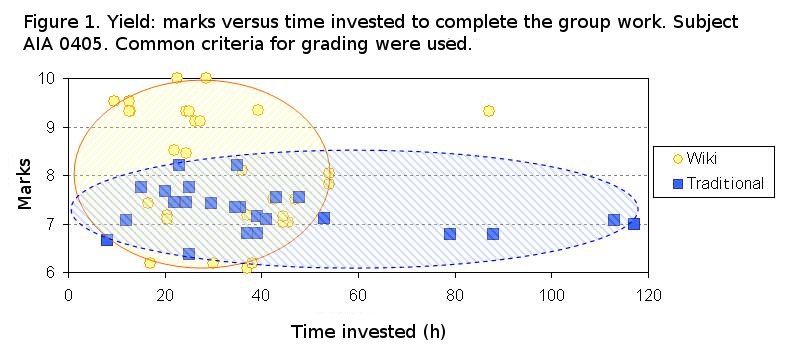
In smaller groups (2-4 pupils for group, generally), where it is not essential to use special methodologies of work in group, there are not evident differences, and the success in the use of the tool might be more related with other factors (described in the full communication of this presentation)
Student satisfaction
There are some differences in the perception of the satisfaction about the method between the pupils of first cycle and those of second cycle. On the one hand, students of first cycle compulsory subjects, if they can meet every day in class and that are more usual to the multimedia technologies (Functional Ecology), then they need more tutelage and direction of the work, and they do not seem to appreciate the advantages of the methodology so much. The students of optional subjects of the first cycle that can not meet every day in class (because most of them work besides studying, as it happens in SIMA "Health and Environment" from Nursery degree), they do appraise it indeed more positively than with the traditional method.
Students of second cycle feel satisfied and recognise the advantages of the Wiki methodology, especially regarding the subject AIA and EAUB. In some specific cases, however, they did not use the tool due to technological handicaps and because they were not used to this methodology of work.
Els alumnes han provat la metodologia Wiki han mostrat un major grau de satisfacció per l'eina que els alumnes que no l'han fet servir (Figura QS 39 – AIA 0405), i han mostrat una mica menys de satisfacció respecte la connexió a Internet (Figura QS44 – AIA 0405).

Figure X. Example for AIA05
Els alumnes que han treballat amb Wiki, creuen la metodologia emprada ha servit per millorar la qualitat final del treball, i els que han emprat el mètode tradicional, creuen que no els ha ajudat tant a fer el treball com els seus companys que si que havien fet servir la metodologia Wiki (Figura Q49 – AIA – 0405).
Tanmateix, tots els alumnes creuen la metodologia Wiki facilita que puguin interaccionar amb les parts del treball liderades per altres membres del grup, i que els altres puguin interaccionar amb les seves. Això es dedueix de què els que han treballat amb metodologia Wiki tenen la sensació que els ha permès millorar la interacció (Figura Q50 – AIA 0405), i els altres van manifestar que la metodologia tradicional amb la que van treballar no va facilitar aquesta interacció (tant desitjada, per altra banda, pel professorat d'aquesta assignatura com a part dels seus objectius docents).

Figure X. Example for AIA05
Time invested by items
It could be analysed only in four subjects (AIA-0304, AIA-0405, EAUB and SIMA). Some of the items were specific of each subject and their comparison has no real meaning in practise for all subjects.
We highlight the following items out of the 16 proposed, due to its interest for the global comparison:
- T3 (Structuring of the work),
- T4 (Writing of the work),
- T6 (Process of giving homogeneity to style and content),
- T8 (Final markup of the work in paper),
- T10 (Exchange of files and materials),
- T12 (Journeys),
- T15 (Meetings in person of the members of the group), and
- T16 (Telematic communication among the members of the group: phone, wiki, e-mail, chat, etc).
The time devoted to structuring the work (item T3) is not necessarily inferior using Wiki methodology respect to traditional methodology, even though there was an exception (AIA 0405).
The time devoted to writing the work (item T4) has been inferior with Wiki methodology. This is a positive result of support to the Wiki tool and methodology.
Another aspect that we wanted to explore was if the Wiki methodology favoured the process of giving homogeneity to the markup, style and content of the work (item T6). Students from AIA and SIMA subjects that worked with Wiki methodology dedicated less time to giving homogeneity than those with traditional methodology, except for the EAUB subject, having in all cases similar presentation quality. It remains unclear if these differences in results are only a consequence of the type of methodology or a consequence of the different interest and commitment of each working group in the matter of work.
In all experiences, Wiki methodology saved, in average for the whole group, about 50% of the time invested on final markup of the work (item T8), compared to students working with traditional methodology. But the teaching staff felt that the single students that made this markup did not have to invest less time through Wiki methodology than the ones with traditional methodology. Suitable data was not collected to verify this hypothesis.
In general, Wiki methodology enables a time saving in the exchange of files and materials (item T10) of about 50%.
Regarding the time dedicated to journeys (T12), even though it seemed that the Wiki methodology saved time in general, results were not conclusive since the time for journeys was tied to the specific characteristics of each work (there were works where longer journeys were required for interviewing experts, and on this matter, Wiki methodology was not able to bring savings).
The time devoted to meetings in person (T15) was in global reduced with Wiki methodology in a clear way, even though in a single case the results were inverted (to see EAUB).
Els alumnes que van fer servir la metodologia Wiki van invertir menys hores en:
- la decisió del tema (ítem 1 ó T1),
- estructuració del treball (T3),
- l'homogeneïtzació del discurs únic del treball (T6),
- l'intercanvi de fitxers i materials (T10),
- i en menys trobades presencials dels membres del grup (T15).
Per altra banda, la metodologia Wiki ha significat una major inversió de temps, respecte la metodologia tradicional, en:
- la inclusió d'imatges en el treball (T5, tot i que van haver molts pocs alumnes que van incorporar imatges, per a qualsevol de les dues metodologies de treball).
No es comenta aquí el cas de la tutoria presencial (T13) o telemàtica (T14) del professorat per que ja ha estat comentada en un apartat anterior.

Figure X. Example for AIA0405
Llegenda de tots els gràfics de "dedicació per ítems" d'aquesta secció
T1 = decisió del tema
T2 = Cerca d’informació
T3 = Estructuració del treball
T4 = Redacció del treball
T5 = Inclusió d’imatges en el treball
T6 = Homogenització del discurs únic del treball
T7 = Formateig final del treball en pàgina Web
T8 = Formateig final del treball en paper
T9 = Preparació de la presentació oral
T10 = Intercanvi de fitxers i materials
T11 = visites-entrevistes amb experts del tema
T12 = desplaçaments
T13 = Tutorització presencial del professorat
T14 = Tutorització telemàtica del professorat
T15 = Trobades presencials dels membres del grup
T16 = Comunicació no presencial entre els membres del grup (telèfon, wiki, correu-e, xat, etc.)
Tutorship
Els alumnes que han treballat amb metodologia Wiki han invertit més hores de tutoria presencial en tots els casos d'assignatures amb dades analitzables: el professor (el mateix en ambdues assignatures) va haver de fer algunes sessions extra dins les hores de classe per tal de donar a conèixer el funcionament bàsic de la tecnologia Wiki i resoldre els dubtes, atès que només entre el 5 % i el 10 % dels alumnes de cada assignatura havien fet el curset específic extra (convalidable com a crèdits de lliure elecció) de formació en la metodologia de treball basada en Wiki. En aquests alumnes el temps invertit en tutoria presencial va ser molt inferior a la mitjana.
El temps dedicat a tutorització en suport telemàtic va ser molt inferior en els que van treballar amb metodologia Wiki que en els que van fer servir metodologia Tradicional, llevat del cas de SIMA, en que l'alumnat que no va fer servir la metodologia Wiki no fa consumir gaire temps en tutoria sobre la realització del seu treball.
Els que han treballat amb Wiki van manifestar haver invertit més hores en tutoria o suport del professorat a nivell presencial que els alumnes que van treballar amb metodologia tradicional (Figura de l'ítem 13 - AIA 0405), però no a nivell telemàtic, en que van invertir menys (Figura de l'ítem 14 - AIA 0405).
La diferent tutorització presencial es podria atribuir a la major necessitat de consultar amb el professor que els que s'està escrivint en el Wiki o parlant pels fòrums electrònics de l'assignatura. Mentre que l'alumnat amb metodologia tradicional ja parlaria més en persona entre els diferents integrants del grup de treball, i per tant, li caldria menys anar a consultar coses bàsiques al professorat.
En canvi, els alumnes que van treballar amb metodologia Wiki haurien requerit menor temps de tutorització per via telemàtic, doncs el Wiki ja els permetria preguntar comentar o fins i tot discutir coses concretes del treball sense haver de trobar-se presencialment.

Figure X. Example for AIA05
Els alumnes que van treballar amb wiki no van quedar tots satisfets amb el suport aportat els professorat per realitzar les pràctiques, mentre que els que van fer servir el mètode tradicional de treball en equip si que van quedar molt satisfets (Figura Q23 – AIA 0405). D'aquí se'n dedueix que, essent la tasca del professorat la mateixa pel que fa al contingut de l'assignatura i pautes per al treball guiat però autònom dels estudiants, la diferència devia ser a causa específicament del mètode de treball basat en Wiki. Val a dir que només 4 dels 31 alumnes que van fer servir el Wiki van apuntar-se prèviament al curset extraordinari de 10 hores (convalidable com a crèdits de lliure elecció) sobre redacció col·laborativa amb Wiki, rebent la resta, poc més de dues hores de formació en Wiki repartides al llarg de les primeres dues sessions presencials amb l'alumnat. Així, seria d'esperar que els alumnes que van treballar amb metodologia Wiki es quedessin amb la sensació de que els calia més suport metodològic (per que el suport sobre el contingut va ser el mateix per a uns i altres) per part del professorat.
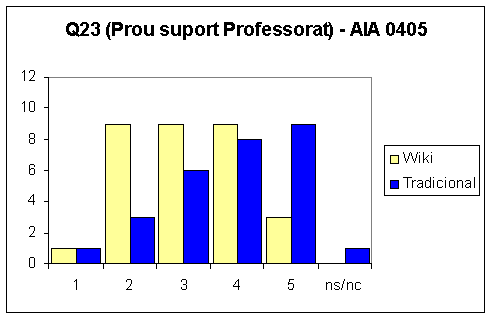
Figure X. Example for AIA05
En conseqüència sembla important que els alumnes que han de treballar amb metodologia Wiki en la seva assignatura, hagin pogut fer abans un curset específic per acostumar-se de manera lenta, gradual i comfortable a les especificitats de la metodologia de treball Wiki a fi i efecte de treure'l el màxim profit amb el mínim de desorientació a causa de la metodologia de treball col·laboratiu basat en Wiki el dia que l'haguessin de fer servir a nivell de producció en situacions reals d'equips de treball col·laboratius.
History
Col·laboren
![[toggle]](img/icons/module.png "[toggle]")
![[toggle]](javascript:icntoggle('mod-Logos_col_laborenr20','module.png'); "[toggle]")

Traduccions automàtiques
![[toggle]](javascript:icntoggle('mod-Traduccio_internostrumr30','module.png'); "[toggle]")

